Save Time: Get 5 Simple Writing Tips
you can put to use in 10 minutes
12 Tips for Writing Website Content That Keeps Readers Reading
Updated 9.17.26
If you own a
website (or write one for someone else), you need two things:
- A plan to get readers to your site
- Tips for writing website content to keep them there longer.
As for the first need: there are plenty of ways to get visitors. You can use high-value keywords to get organic traffic, plant inbound links, and generate traffic through your newsletters and social media links.
But once users find your site, how do you get them to hang out for a bit?
You want them to stay for a spell.
It’s plenty easy for a reader to click off and hop over to the next link in the search engine results. One second, they’re on your website. The next, they’re gone.
That’s why I’ve put together these tips for writing website content. They’re simple strategies you can use as you write your website. They’re based on how readers use the web. And I use them myself.
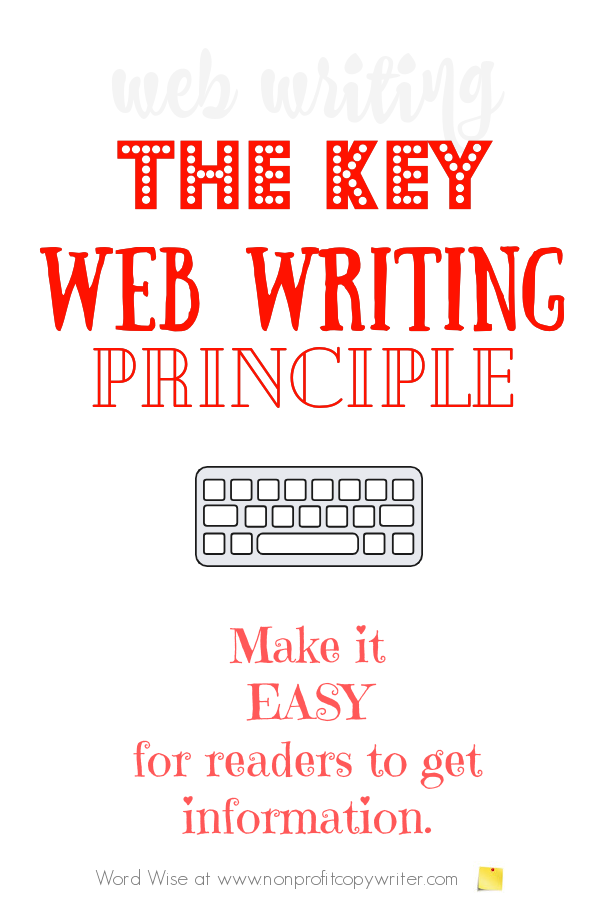
The principle behind these tips for writing website content
The key principle you need to embrace is this: Your website provides helpful information. Your job as a writer is to make it easy for readers to get that information.
If you don’t make it easy, Susie Q User will go somewhere else—to a site that simplifies things for her. Or to Chat GPT.
Your site can be the one that makes it easy for Susie and other visitors to get the information they need … and deliver it in a fun way with a human behind it.
These tips for writing website content work for almost any kind of site, whether you manufacture carpet dye, write a mommy blog, run a nonprofit, sell gardening supplies, or manage a forex exchange website. The subject may change. The reader’s online need doesn't.
- Your reader is busy.
- She has a question.
- She wants an answer.
- And she doesn't particularly care how hard you worked to create the page.
That's not an insult. That's simply how people use the web.
So write for the reader who is scanning, searching, comparing, clicking, and deciding whether your page is worth another 30 seconds.
Make it easy for her.
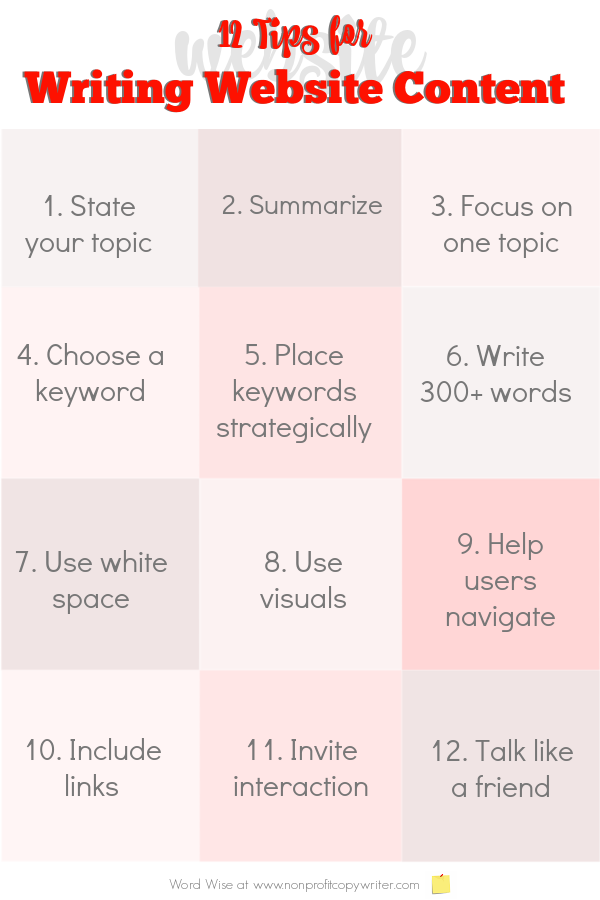
12 tips for writing website content that’s easy to read
1. State your topic
When a user clicks on your webpage, you have a very short window to capture their attention -- 15 seconds to capture their attention. That's why you need to get to the point ASAP.
Tell your reader what the page is about in the title and opening lines. Don't make your reader work to figure it out.
For instance, did you click on this page because you wanted to know how to outline a book? Nope. You're here because you want to learn a few tips for writing website content that keeps readers reading. You knew you were in the right place from the get-go.
That's exactly what you want to do for your readers.
Compare these two openings:
- Vague: “Creating effective online communication requires a thoughtful approach to the many elements that contribute to a successful digital presence.”
- Direct: “Writing website content is different from writing a magazine article. Online readers scan first, so your job is to make your information easy to find and easy to understand.”
Web writer's tip: Don't make readers dig for the point. Give them the point. Be the website that tells your reader exactly what they’re going to get.
2. Summarize at the top
Online readers often start at the top of the page and then scan down to find specific answers they need.
Make it easy for them.
Once you state your topic in the title and opening sentence, use a summary paragraph or two to lay out the parts of that topic you'll cover or the specific angle you'll explain on the page. Think of this opening as a little roadmap.
For example ....
“This guide explains how to choose a freelance writing niche, find your first clients, set your rates, and build a simple marketing system.”
Your reader now knows what's coming. She may decide to read the entire article. Or she may scroll down to the section on setting rates because that's what she needs today. Either way, you've helped her. And that's the point.
A useful introduction doesn't need to be long. In fact, don't spend 500 words warming up to an article that could have told the reader what she needs to know in the first 50.
Web writer’s tip: Give readers the map before you take them on the trip.
3. Focus on just one topic
If Robert Reader found your page through a search or referral link, that means he had a question that your page promised to answer. Make sure you provide that answer on your page.
Don't stray off topic. For instance, you may be tempted to use your Donate page to wax eloquent about your organization's history, but you'll just confuse your reader. Stick to one topic per webpage. If you've got more content to cover than what you promise at the top of the page, create additional pages.
A focused page is easier for readers to understand, easier to navigate, and easier for search engines to interpret. Think about the difference between these two pages:
- Page A: “Everything You Need to Know About Our Organization”
- Page B: “How Your $50 Donation Helps Feed a Family”
Page A might contain information about your history, staff, programs, mission, annual report, volunteer opportunities, donation process, and upcoming events. Readers will be overwhelmed … and click away.
Page B has a job. It answers one question.
Web writer’s tip: When your webpage has one clear job, it's much easier to write—and much easier for your reader to use.
4. Choose a main keyword
Keywords are terms and phrases that define a piece of content. Each page on your website should have a clear primary topic or search intent. Choose one main keyword or key phrase that represents what the page is about. For example, you may choose a main keyword for a specific page on your site such as ....
- “how to write a fundraising letter”
- “vacuuming your Toyota Highlander”
- “what are emerging markets”
Build your content around that topic.
You can—and should—use related words and phrases naturally throughout the page. But don't turn your article into a game of keyword bingo. Search engines have become much better at understanding topics and related concepts.
How often should you use your primary keyword?
Don’t repeat your main keyword every few sentences, or Google will think you’re trying to game its algorithm. And readers will think you’re writing for 6-year-olds.
Your first responsibility is to the human being reading the page. If your keyword appears naturally, great. If forcing it into a sentence makes the sentence sound ridiculous, leave it out.
And don’t obsess over hitting an exact keyword density. You may have heard the old advice about using your keyword every 200–300 words. That's not a magic formula. In fact, awkwardly stuffing the same phrase into your content can make your writing worse—and potentially make the page less useful.
Instead, use your main keyword naturally and include related terms that help you thoroughly answer the reader's question.
Web writer’s tip: Write for people first. Optimize for search second.
Not sure about the main keywords for your page? Use this guide.
5. Place keywords strategically
Speaking of keywords, place your primary keyword or key phrase in logical, useful locations on the page, such as …
- The page title
- The main heading
- The URL, when practical
- The opening paragraph
- Relevant subheads
- Image alt text when it accurately describes the image
- The body of the content where it naturally fits
- The meta title and description
For example, an article targeting “vacuuming your Toyota Highlander” might naturally include additional keyword phrases such as:
- driver’s side floor
- floor mats
- cargo area
- hand vacuum
- extension cord
That's a much more natural way to build topical relevance.
Web writer’s tip: Alt text is primarily for accessibility, not keyword stuffing. If your image shows a hand-held vacuum, describe the image accurately. Don't turn the alt text into a pile of search terms.
6. Write
enough to answer the question
Long pages or short pages? Both have value.
A 1,500-word article can give you room to explain a complicated subject thoroughly. A 400-word page may be exactly what someone needs to answer a simple question.
Don't write 2,000 words because you've heard that Google likes 2,000-word articles. Write as much as the topic requires.
- If a reader searches “How do I remove the floor mats from my Toyota Highlander?” she doesn't need a 3,000-word dissertation. Give her the answer.
- If she searches “How to choose a car vacuum,” however, there's more ground to cover: price, features, power source, attachments, portability, storage … that topic deserves more room.
Your goal isn't a specific word count. Your goal is complete, useful content without unnecessary padding.
Web writer’s tip: Avoid publishing pages that contain so little useful information that the reader is forced to leave your site to get the rest of the answer. And don't add fluff simply to make a page longer. Your reader can smell fluff.
7. Use white space
Users don't necessarily read online content word-for-word from beginning to end.
They scan.
When a tidbit captures their attention, they'll pause and read a bit more deeply. That's why your website content needs plenty of white space.
- Write short sentences.
- Write short paragraphs.
- Use bullet lists.
- Break up the content with subheads.
- Use bold text sparingly to emphasize genuinely important points.
- Don’t be afraid of a one-sentence paragraph.
Compare Version #1 and Version #2.
Version #1: “Your website visitors are busy and they're probably doing several things at once while they're reading your page so if you give them enormous blocks of text they're likely to skip over them because it's difficult to find the information they're looking for.”
Version #2:
Your website visitors are busy.
They're probably doing several things at once while they're reading your page.
So don't give them enormous blocks of text.
Make the information easy to scan.
Same information … but Version #2 is much easier to read.
Web writer’s tip: White space isn't wasted space. It’s a navigation tool.
8. Include visuals
All words and no pictures make your website a dull one. Visuals can help readers understand, remember, and navigate information.
Depending on your subject, visuals might include:
- Photographs
- Infographics
- Charts
- Diagrams
- Screenshots
- Videos
- Illustrations
- Maps
- Before-and-after images
- Pull quotes or other visual elements
The trick is to make the visual relevant. Don't slap a random stock photo of a smiling woman at a laptop onto an article about accounting simply because you need a picture.
Ask yourself, Does this visual help explain, demonstrate, reinforce, or break up the content?
- If yes, use it.
- If not, skip it.
And remember accessibility. Give images useful alt text when appropriate, make sure text in graphics is readable, and don't rely on color alone to communicate important information.
Web writer’s tip: A good visual isn't decoration. It's another way of delivering your message.
9. Help users navigate
Is your user's experience easy and trouble-free? It should be.
- Use site navigation that makes sense.
- Make it clear where the user should go next to get additional information.
- Optimize the site for mobile devices.
- Check links to make sure they're active.
- Make headings descriptive rather than clever.
- Give visitors obvious ways to move around your site.
Imagine that your website is a grocery store. You don't want visitors wandering around shouting, “Where the heck are the tomatoes?” You put up signs. Your website needs signs, too.
- Your main navigation is one set of signs.
- Your headings are another.
- Your internal links are another.
- Your calls to action are another.
All of them answer your reader's same basic question: Where do I go next?
Web writer’s tip: Give readers visual signposts so they can navigate your site with no snags.
10. Include helpful links
Users are looking for information—and not just the information they find on the particular page they landed on. They want additional morsels about related topics.
Help them out. Link them to other pages on your site that address those topics.
These contextual links are useful to readers because they let them explore a subject without having to return to Google and start another search.
Suppose you're writing an article about starting a writer's website. You might naturally link to pages about …
- Planning your website
- How to create a navigation structure
- Which pages to write first
- How to write a home page
- How to use pillar pages
Notice that these links aren't random. They're related to what the reader is already doing.
That's the secret.
2 reasons to create links
- You create links because the reader might want or need the additional information—not simply because you want more clicks.
- You create internal links to help search engines discover and understand the relationships between pages on your website.
So helpful links serve two audiences: Your reader. And your search engine.
Web writer’s tip: Create internal contextual links that serve the reader first – and search engines second.
11. Invite interaction
Your website may have static content, but that doesn't mean your relationship with readers has to be static. Invite visitors to take the next step. That might mean:
- Sign up for your newsletter
- Download a free guide
- Click to another page on your site
- Request a quote
- Schedule a consultation
- Make a donation
- Buy a product
- Read another article
- Leave a comment
- Follow you on social media
- Contact you
Give the reader a clear call to action. And don't assume that every page needs the same call to action. Match the action to the reader's needs and where they are in their relationship with you.
- A blog post might invite someone to download a free checklist.
- A product page might say “Buy Now.”
- A nonprofit story might ask readers to “Give Today.”
- A service page might say “Let's Talk.”
Web writer’s tip: One clear next step is usually better than a dozen competing ones. If you put five buttons at the end of a page, you may leave your reader wondering which one matters. Instead, tell them one thing to do next.
Write better web content right away when you use these 5 simple tips.
12. Talk like a friend
Your reader is on your site to get information. He wants an answer to his problem. If your wording is too highbrow, your user may feel as though the content wasn't written for him. And if you use insider lingo without defining terms, he'll get confused.
But what if you talk like you're having coffee with your reader? He feels valued because you speak in plain language.
You don't need to eliminate sophisticated ideas. In fact, it takes a skilled writer to package difficult concepts in simple language. Write in language an intelligent person can understand without reaching for a dictionary. For instance …
- Version #1: “We leverage strategic synergistic solutions to optimize stakeholder engagement.”
- Version #2: “We help organizations build stronger relationships with the people they serve.”
Version #1 sounds like it escaped from a corporate conference room.
Version #2 sounds like a human being talking to another human being.
- Use “you.”
- Use active voice.
- Choose familiar words.
- Explain unfamiliar terms.
- Cut unnecessary throat-clearing.
- Read your content aloud. If you wouldn't say the sentence to a real person, rewrite it. In doing so, you've made it easy for your reader to get answers and understand.
Web writer’s tip: Be the writer that’s a friend on paper.
One bonus
tip: Write for the reader you actually have
There's one final mindset shift that can make all 12 of these tips for writing website content work better.
Stop thinking about “website visitors” as a giant anonymous crowd. Think about one person.
- Who is she?
- What brought her to this page?
- What does she already know?
- What does she need to know?
- What question is she likely to ask next?
- What might confuse her?
- What action would actually help her?
This doesn't mean you literally need to know your reader's name. It means you need to write with a specific person and specific problem in mind. That's how you avoid generic website content.
Instead of writing, “Our organization provides comprehensive services designed to meet the diverse needs of our community.”
You might write, “If you're a parent who needs help finding affordable child care, we're here to help you find your options.”
Now I know who you're talking to. And I know why I should keep reading.
Identify your ideal reader with this helpful worksheet.
Before you
publish: Give your webpage the 30-second test
Here's a simple test you can use before you hit Publish. Open your webpage and look at it without reading every word. Give yourself about 30 seconds. Can you tell ...
- What is this page about?
- Who is it for?
- What question does it answer?
- What are the main points?
- Where should I click next?
- What action should I take?
If the answers are yes, you've probably created a page that's easy to navigate.
If the answers are no, don't panic. Go back and make the page easier to scan.
- Strengthen the headline.
- Rewrite the opening.
- Add descriptive subheads.
- Break up long paragraphs.
- Move important information higher.
- Add useful links.
- Clarify the call to action.
You don't necessarily need more content. You may simply need better organization.
The bottom
line on writing website content that keeps readers reading
Writing for the web isn't about cramming as many words, keywords, links, and graphics onto a webpage as possible.
It's about communication.
Your reader arrives with a need. Your job is to help her meet that need with as little friction as possible.
- Tell her what she's getting.
- Give her the answer.
- Organize the information so she can find it.
- Use plain language.
- Break up the page.
- Add helpful visuals.
- Link to useful related information.
- Then give her a logical next step.
Do those things consistently, and your website becomes more than a collection of pages.
It becomes a helpful place.
And that's the kind of website people are more likely to return to, recommend, bookmark, subscribe to—and yes, stick around and read.
More Website Content Writing Tips
3 Simple Tips for Writing Better Web Pages ...
3 Things You Need for Planning a Website (or Updating One) ...
Pillar Pages: what they are and why you need to write them ...
6 places to use keywords in web pages and blog posts ...
3 Ways to Write Conversationally Online (and Off) ...
3 Writing Tips to Help You DIY Graphics for Content ...
Picture This: Where to Find Free Images for Your Blog or Website ...
20 Types of Evergreen Content that Build Traffic on Your Website ...
The 20-Minute Blogger: Take a Writing Course That Saves Time ...
The 20-Minute Blogger (eBook or paperback) ...
More Online Writing Tips on our Pinterest board ...
Return from 12 Tips for Writing Website Content to
Nonprofit Copywriter home
As an Amazon Associate I earn from qualifying purchases.
Share This Page

Named to 2022 Writer's Digest list
BEST GENRE/NICHE WRITING WEBSITE

Stop Wasting Time!
Grab your exclusive FREE guide, "5 Simple Writing Tips You Can Put to Use in 10 Minutes or Less"
 Subscribe To This Site